
AI4NYP+ · Field Story · Enugu State, Nigeria
From Soil to Scale: How AI Helped Mrs Chioma Reclaim Her Harvest and Her Voice
A Raspberry Pi, a dialect the machine finally speaks, and a pepper farmer who stopped spraying and praying.
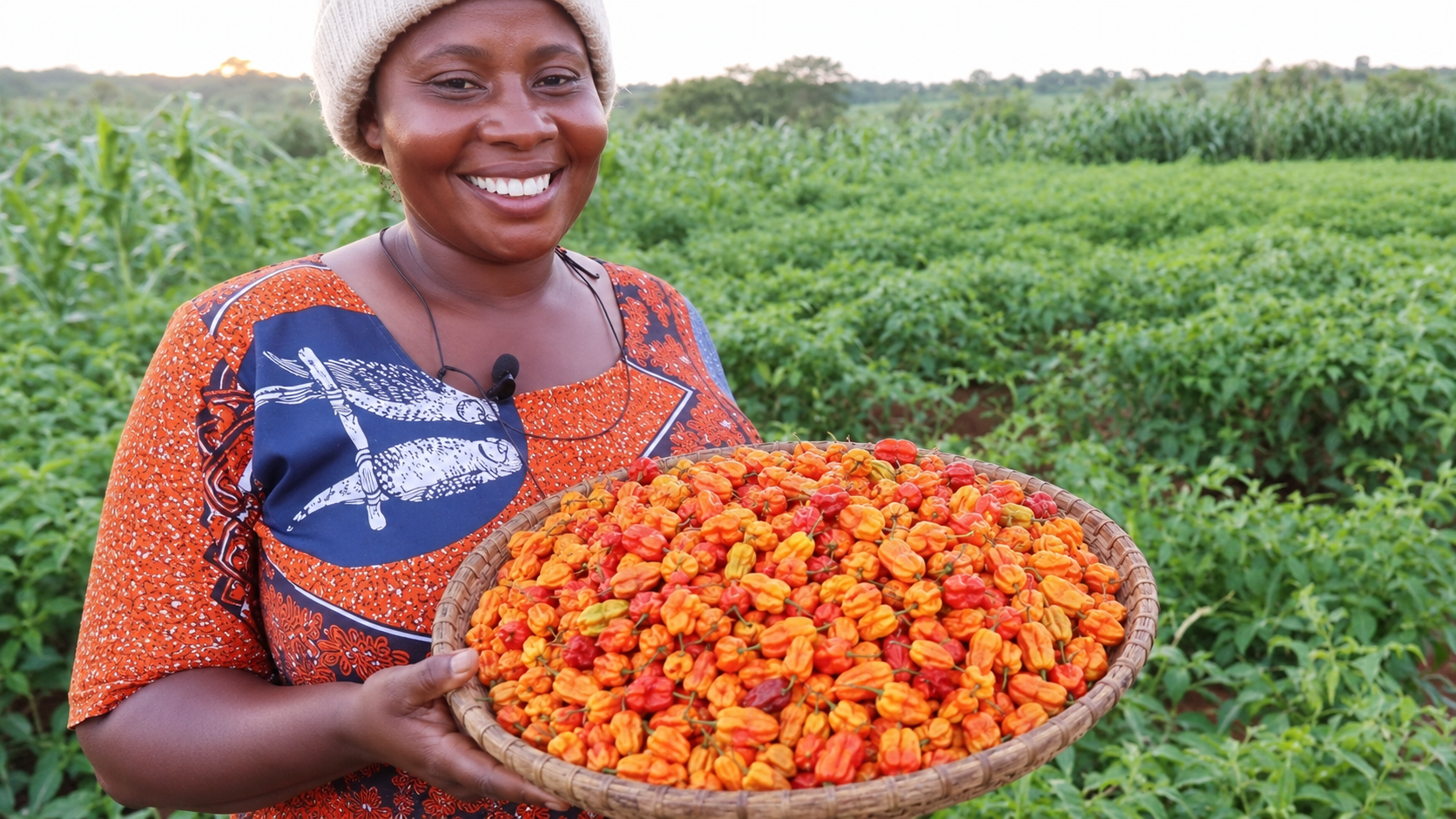
Mrs Chioma among her Nsukka Yellow Pepper plots, Enugu State.
The harmattan dust had barely rested over Enugu State when Mrs Chioma first noticed the yellowing on her pepper leaves. For years, that small discolouration meant the same thing: a long walk to ask a neighbour what it might be, a guess at which chemical to buy, and a silent hope that she had guessed right. Tending her plots of Nsukka Yellow Pepper, she relied on visual guesswork to identify crop diseases, spent heavily on treatments that rarely worked as promised, and sold her harvest using traditional, imprecise measures, leaving her at the mercy of middlemen. Like many rural women farmers in Nigeria, Chioma worked the land with hard work but stayed trapped in a cycle of low yields, monetary pressure, and quiet resignation.
Chioma’s story is not unique. Across pepper-farming communities in Enugu State, disease often spreads faster than the knowledge needed to fight it, and the chemicals farmers can access are frequently mismatched to the problem at hand. When a crop fails, the loss is rarely just financial; it erodes the confidence of women who have spent decades reading their own soil, only to be told that their instincts aren’t enough.
The turning point occurred through a training session Chioma almost didn’t attend. Past encounters with researchers’ interventions had ended in unfulfilled promises, and she saw little reason this would be different. But this project, led by Prof. Chinenye Anyadike of the Association of Professional Women Engineers of Nigeria (APWEN), arrived differently. Under the AI4NYP+ project, part of the wider AI4AFS+ initiative, Prof. Anyadike’s team had recognised early that the technology would only take root if it respected local knowledge and the infrastructural realities of rural Enugu. Rather than building a cloud-dependent app that assumed a dependable internet connection, the team designed a lightweight, solar-powered disease-detection system that runs offline on a Raspberry Pi, a low-cost, low-power computer hardy enough for life in a pepper field. When Chioma finally held the device up to a sick leaf, it answered her in her own dialect, naming the disease and explaining what to do next.
What changed for Chioma wasn’t only the tool but her relationship to the knowledge behind it. The training was led by peer “super farmers” — neighbours like Ngozi who had already put the device to work in their own fields — and grounded in participatory design, and Chioma was never solely a passive user. She became a co-creator, helping to label thousands of pepper leaf images so the underlying YOLOv11n model could learn to recognise local disease symptoms such as Nkeroaka (leaf coil) and Ebola (leaf blight) by the names farmers already used for them. For the first time, her indigenous knowledge was formally built into the technology meant to serve her, rather than imposed over it.
Data, kept close to home
What Chioma may not always see from her field, but which matters just as much, is what happens to the images she captures. Every scan she takes feeds a system designed to keep that knowledge within the communities that built it, refining disease recognition for the next farmer and tracking how symptoms shift across seasons.
Her data works for her cooperative rather than on it — a quiet but deliberate choice in a project built on the principle that responsible AI should be gender-responsive, disability-inclusive, and community-owned.
The shift was tangible. Confident in the system’s early, accurate diagnoses, Chioma replaced reactive chemical spraying with timely treatment and gradually phased out expensive synthetic inputs in favour of organic fertiliser. Her costs dropped, her soil health improved, and her yields surged. That predictability gave her the courage to scale: she expanded her cultivated land from two plots to fifteen. But the more lasting change happened off the field. Inspired by the project’s emphasis on communal resilience, Chioma and her fellow farmers formed a cooperative, setting uniform prices, pooling logistics, and negotiating with buyers as a unified bloc rather than as individuals exposed to exploitative middlemen.
This kind of barrier is well documented beyond Chioma’s field. Smallholder farmers across the continent often diagnose crop disease too late or with too little information, a gap that agricultural research has long linked to thin extension networks and limited access to localised, timely guidance. The cost of that gap is rarely abstract; it is measured in harvests lost to misapplied chemicals and seasons spent guessing. Tools that arrive without local language, local symptoms, and local trust risk becoming another resource for rural women farmers without ever truly reaching them.
The economic leap was visible in Chioma’s own life: she recently purchased a bus to streamline her farm logistics and expand her market reach. The once-hesitant farmer now stands at the front of cooperative meetings, explaining how the AI works in her own dialect, mentoring struggling peers, and advocating for women’s land and market rights.
Chioma’s experience is still one pilot within a much larger challenge, and scaling it will take deliberate choices in how agricultural AI is funded, built, and deployed. To developers and data scientists: design alongside farming communities rather than for them, building interfaces around local dialects and the real, often offline, connectivity of a pepper field, not the bandwidth of a city office. To funders and decision-makers: favour tools that can demonstrate community ownership, participatory data collection, and access to farmers without smartphones, including the SMS alert integration AI4NYP+ is now developing to reach those still left out. This is not about lowering the bar for innovation; it is about insisting that innovation actually reaches the people it claims to serve.
Today, Mrs Chioma’s farm is more than a source of income. It is a working blueprint for what happens when artificial intelligence is designed with empathy, trained on local knowledge, and placed in the hands of those who understand the soil best; what we might call community-owned AI. The harmattan still settles over Enugu State each year, and the leaves still sometimes turn yellow. But Chioma no longer waits to guess. She lifts her device, reads the answer in her own language, and acts. As AI4NYP+ scales its growth across Nigeria, her story reminds us that the future of African agriculture isn’t just smart or automated; it is inclusive, resilient, and truly human.
AI4NYP+ · AI4AFS+ Initiative · APWEN